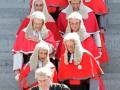
Separation of powers
In New Zealand the judiciary (which interprets and enforces the country’s laws) is separate from both the legislature (Parliament, which makes the laws) and the executive (which runs the day-to-day affairs of government). Judges are appointed by the governor-general. Convention denies the government the authority to direct judges and the Constitution Act spells out the limited circumstances in which they can be removed from office.
The courts
New Zealand has a hierarchy of courts:
- District Courts
- the High Court
- the Court of Appeal
- the Supreme Court, which replaced the Judicial Committee of the Privy Council as New Zealand’s final court of appeal in 2003.
In New Zealand courts, judges act as neutral referees while opposing sides present their cases. New Zealand inherited the system of trial by jury from Britain.
Special courts
The Family Court and Youth Court are divisions of District Courts. The Employment Court hears cases brought under the Employment Relations Act, and the Environment Court hears matters raised under the Resource Management Act. The Māori Land Court rules on matters concerning land held on tenures peculiar to Māori.
Justices of the peace and tribunals
Individual citizens appointed justices of the peace perform minor judicial functions. Some tribunals, commissions and authorities have quasi-judicial roles. Commissions of inquiry are temporary bodies set up to look into specific matters.
The law
The law enforced by the New Zealand courts is a combination of the following laws:
- Common law. English common law became part of the law of New Zealand in 1840. New Zealand common law now also includes law derived from decisions made by New Zealand courts.
- Statute law. These are the current acts of the New Zealand Parliament.
- United Kingdom statute law. A small number of United Kingdom statutes remain part of the law of New Zealand.
- Subordinate legislation. Regulations are made by order-in-council under powers delegated by Parliament, and by-laws are made by local authorities.