New Zealand as a colony
In 1840 Britain made New Zealand initially a dependency of New South Wales, and at the end of that year it became a separate colony. As a colony, it adopted institutions of government and political practices from the ‘mother country’.
To rule the country the government of the United Kingdom appointed governors, advised by appointed executive and legislative councils, but accountable only to the Colonial Office in London.
New Zealand becomes self-governing
In 1852 the British Parliament passed the New Zealand Constitution Act, which provided for an elected House of Representatives and an appointed Legislative Council. The General Assembly (the House and Council together) first met in 1854.
New Zealand became effectively self-governing in all domestic matters (except ‘native policy’) in 1856, when responsible government (the executive having the support of a majority of the members of the House of Representatives) was accepted. Control over native policy passed to the colonial government in the mid-1860s. The New Zealand government became fully responsible for its own foreign relations in 1935, when the first Labour government explicitly claimed such responsibility.
Mightier than the sword
New Zealand took an individual stance in world affairs only slowly. One small but significant step came in 1919 when the prime minister, William Massey, signed the Treaty of Versailles, which ended the First World War. Previously British prime ministers had signed such major international treaties on behalf of New Zealand. The pen Massey used is on display in Parliament Buildings in Wellington.
A unitary state
The 1852 New Zealand Constitution Act established a system of government in which some responsibilities and powers were held by provincial governments. The provinces, which had elected councils and superintendents, were particularly active in promoting immigration, and in land sales and development. But the colonial Parliament could abolish the provinces by a simple majority vote, and the provincial governments disappeared in 1876. Since then, New Zealand has had a unitary system of government, with Parliament the single and supreme source of power. The New Zealand Parliament has had only one chamber, the House of Representatives, since the Legislative Council was abolished in 1950.
Steps to full independence
New Zealand did not have to fight for the right to govern itself, and moved slowly down the road to full independence:
- In 1907, six years after its six neighbouring colonies had formed the Commonwealth of Australia, New Zealand was styled a dominion rather than a colony.
- In 1947 New Zealand adopted the Statute of Westminster (passed by the British Parliament in 1931), which confirmed that the New Zealand Parliament alone had the power to make laws for the country.
- In 1986 the Constitution Act ended residual British legislative powers, making New Zealand formally responsible (as it had been in practice for many years) for its own system of government.
- In 2003 the right of appeal from New Zealand courts to the British Privy Council was abolished.
Capital gains and losses
In 1840 New Zealand’s only sizeable European town was Kororāreka in the Bay of Islands. After British sovereignty had been proclaimed, Lieutenant-Governor William Hobson established his seat of government at nearby Okiato. He named the new capital Russell. But in 1841, Hobson moved the capital to the shores of the Waitematā Harbour, where he had founded Auckland. The site of ‘New Zealand’s first capital’ sank back into obscurity. In 1865 the seat of government was moved again, from Auckland to Wellington.
The capital
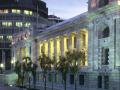
The seat of government was moved from the Bay of Islands to Auckland in 1841 and from Auckland to Wellington in 1865.