Story summary


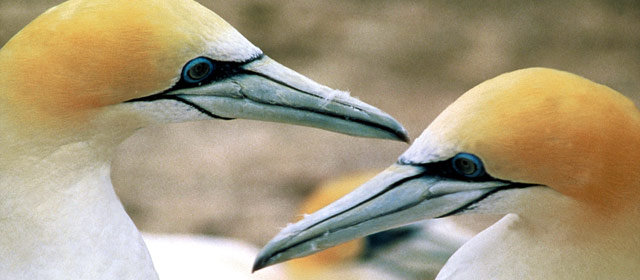
Australasian gannets are beautiful big seabirds – snowy white, with a golden head, and black-tipped wings that reach 2 metres across. They live in colonies around the coasts of New Zealand and southern Australia, and their numbers are growing. They can live for 30 years.
Boobies are related to gannets. The masked boobies of the Kermadec Islands have colonies on the Herald Islets, Macauley Island and Curtus Island.
Where do New Zealand’s gannets live?
Gannets breed at 24 places around the coast, including many islands. There are three colonies where people go to see hundreds or thousands of birds up close:
- Cape Kidnappers. This rocky headland is in Hawke’s Bay. Birds started breeding here about 1880.
- Muriwai Beach. The first birds arrived here, near Auckland, from a nearby island in 1979.
- Farewell Spit. This, the only sea-level colony, started in 1983.
Chicks
In spring and summer the birds live in colonies, where they find a mate for life. Each pair has one chick every year. The pale blue egg is laid between September and December and both parents take turns sitting on the nest. After about six weeks the egg hatches. The chick is born without feathers, but in one month it has white fluffy down. Both parents feed the chick. By three months it is fat, with brown speckled feathers. Every day it stretches and flaps its growing wings.
Flying away
At just four months of age, the young birds fly to Australia, nearly 3,000 kilometres away. This is remarkable because they have never flown or even found food before. Many die on this dangerous journey. After three years, the birds return as adults. Mostly they stay and breed in New Zealand.
Food
To catch fish, gannets do a spectacular dive-bomb. They plunge head first into the sea, at up to 145 kilometres an hour. Their diet is mainly small fish such as anchovies and pilchards. There is plenty of food for them in New Zealand waters.
Masked boobies
These large birds look like gannets, but without the yellow head. They prefer warmer regions, and the only New Zealand colonies are on the subtropical Kermadec Islands, where there are about 200 breeding pairs.