Story summary



Treaty of Waitangi
When the Treaty of Waitangi was signed in 1840 there was a worldwide movement to abolish slavery. People had seen the negative effect of colonisation on the indigenous people of countries like Australia. Colonists believed the Treaty of Waitangi was fair because it offered Māori the rights of British citizens.
The signing of the Treaty made it easier for settlers to acquire land. While many of them only mixed socially with other settlers, some male colonists consolidated their position by marrying Māori women and accessing land as whānau or kin. These Pākehā were often key ‘go-betweens’, connecting settlers and Māori. At the same time, the children of Māori and Pākeha settlers were defined as ‘half castes’ and white settlers often saw themselves and their culture or ‘civilisation’ as superior to Māori culture. Racism, the belief that some people were superior to others on the basis of their ethnic origins, existed alongside recognition in the Treaty of Māori as British citizens and official encouragement of marriage between Māori and settlers.
From the late 1840s chiefs protested to Queen Victoria about breaches of the treaty. Those Pākehā who sided with Māori were known as ‘philo-Māori’.
Racism in New Zealand
British settlers considered that their culture, religion and technological innovation meant that they were superior to Māori. However, Māori were often seen as superior to other indigenous peoples and suitable candidates for assimilation into British institutions and customs. Māori were represented in Parliament and incorporated into sports teams, but at the same time discriminated against in various ways. Between 1877 and 1951 there was a separate census for Māori and until 1945 they did not receive full old age and widows’ pensions. Bars, hotels, cinemas and swimming pools sometimes excluded Māori and some properties were not available to rent. These forms of racial discrimination were increasingly challenged in the mid-20th century, together with discrimination against Chinese immigrants, other Asians and people from the Pacific Islands.
Racism in sport
Rugby is the national game of both New Zealand and white South Africa. Teams in South Africa were selected on the basis of race – the country had an apartheid system which segregated races.
When South Africa’s Springbok team toured New Zealand in 1921 they played an all-Māori team. People in South Africa were angry. When the All Blacks toured South Africa in 1928 all Māori players were excluded, even outstanding All Black George Nēpia.
New Zealanders began protesting against racism in sport. In 1959 the Citizens' All Black Tour Association was set up to oppose another All Black tour of South Africa. Their slogan was ‘No Maoris, no tour’.
Pākehā challenges to racism
Many Pākehā New Zealanders believed New Zealand had ideal race relations. But discrimination against Māori, Chinese and other Asian immigrants was widespread.
The Citizens Association for Racial Equality (CARE) began in 1964. This mainly Pākehā organisation protested about an all-white All Black tour to South Africa planned for 1967, and also opposed the confiscation of Māori land.
Anti-racism and Treaty of Waitangi activism
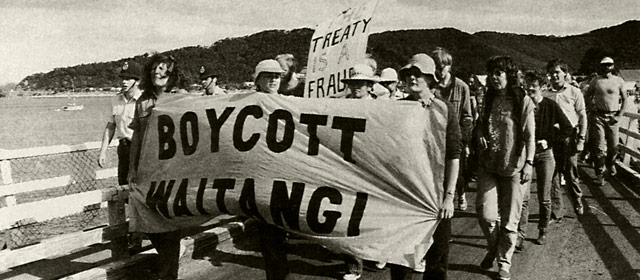
Māori set up their own human rights groups. Ngā Tamatoa campaigned about Māori land, Māori language and breaches of the Treaty of Waitangi. In 1975 there was a big march (hīkoi) to protest against the loss of Māori land.
Police dawn raids on the homes of Pacific Islanders whose temporary work permits had expired led to protests by Ngā Tamatoa, the Polynesian Panthers, trade unions and other groups. People highlighted racism in the police, the court system and in government institutions.
1981 Springbok tour
Many anti-racist groups joined to protest against the tour of New Zealand by a Springbok rugby team in 1981. More than 1,500 people were charged with protest offences.
Waitangi Tribunal
From 1985 the Waitangi Tribunal was able to investigate breaches of the Treaty of Waitangi by the Crown since 1840. The treaty became entrenched in New Zealand law following a Court of Appeal ruling that treaty principles applied in the present day.
Human rights
The Office of the Race Relations Conciliator was established in 1971 to promote positive race relations in New Zealand, and in 1977 the Human Rights Commission, Te Kāhui Tika Tangata, was formed to promote a wider range of human rights issues. In 2001 the office of the Race Relations Conciliator merged with the Human Rights Commission. The commission investigates complaints of discrimination, including in education, accommodation and employment.
Cultural diversity
Migrations from Polynesia from the 1960s and Asia in the 1990s and early 21st century, together with the arrival of refugees from around the world, have made New Zealand a more culturally diverse country. New forms of racism such as prejudice against new migrants pose new anti-racist challenges.

